
National Water Resources Plan (NWRP)
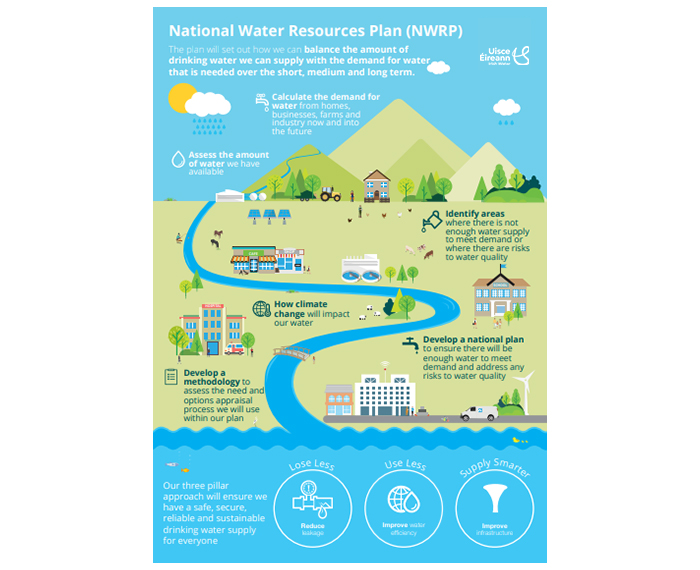
The NWRP is our plan to identify how we will provide a safe, sustainable, secure and reliable water supply to our customers for now and into the future whilst safeguarding the environment.
The NWRP sets out how we will balance the supply and demand for drinking water over the short, medium and long term. It is a 25-year strategy to ensure we have a safe, sustainable, secure and reliable drinking water supply for everyone.
Following on from the public consultation on Phase 1 NWRP draft Framework Plan and associated environmental reports, the submissions and observations received from public consultation have been taken into consideration, and the NWRP Framework Plan updated.
The NWRP Framework Plan has now been adopted, accompanied by a Strategic Environmental Assessment Statement and an Appropriate Assessment Determination. A Consultation Report summarising feedback received during the public consultation has also been published.
NWRP Framework Plan Publications
- NWRP Framework Plan
- NWRP Framework Plan - Non-Technical Summary (NTS)
- Appendix A - Consultation
- Appendix B - Planning Scenarios
- Appendix C - Supply Assessment
- Appendix D - Level of Service
- Appendix E - Drought Planning
- Appendix F - Climate Change
- Appendix G - Licensing Constraints
- Appendix H - SELL Report
- Appendix I - Headroom
- Appendix J - Barriers
- Appendix K - Residuals
- Appendix L - SDB Summaries
- Appendix M - Environmental Costing
- Appendix N - Fine Screening
- AA Determination Statement
- Natura Impact Statement (NIS)
- Appendix A - AA Screening Report
- Appendix B - List of SACs and SPAs
- Appendix C - Water Dependent QI Species and Habitats
- Appendix D - Water Dependent QI Bird Species
Regional Water Resource Plans
As this is the first NWRP, the preparation of the plan has been divided into two distinct phases, the combination of which will become the final NWRP. As outlined above, Phase 1 was carried out in 2021 and the NWRP Framework has been adopted. In Phase 2 of the NWRP, we summarised the needs across the 539 individual water supplies and identified the solutions to address these needs. Due to the large number of supplies in Ireland, we delivered Phase 2 as four Regional Water Resources Plans:
- Regional Water Resources Plan: North West (RWRP NW)
- Regional Water Resources Plan: South West (RWRP SW)
- Regional Water Resources Plan: South East (RWRP SE)
- Regional Water Resources Plan: Eastern and Midlands (RWRP EM)
Each of the four draft RWRPs and associated environmental reports had their own public consultation phases over the course of 2021, 2022 and 2023 and have since been adopted by Uisce Éireann.
Why do we need a National Water Resources Plan?
Ireland is not a water stressed country. We need to operate our water network to cater for growth and optimise this great natural resource. Water is part of our everyday lives. It is essential to everything we do. Recent droughts and storms have left some customers with no water or reduced water, including a water conservation order (hosepipe ban) for the first time in Ireland.
To prevent this happening in the future we have to plan ahead. How we plan our water resources today will determine the water we can provide now and into the future. Uisce Éireann's first National Water Resources Plan outlines how we can do this.
Our Solution
Uisce Éireann aims to ensure that all of our customers have a safe and reliable drinking water supply and to safeguard our water for our future. Our plan is to use a three-pillar approach:
1. Lose Less
2. Use Less
3. Supply Smarter
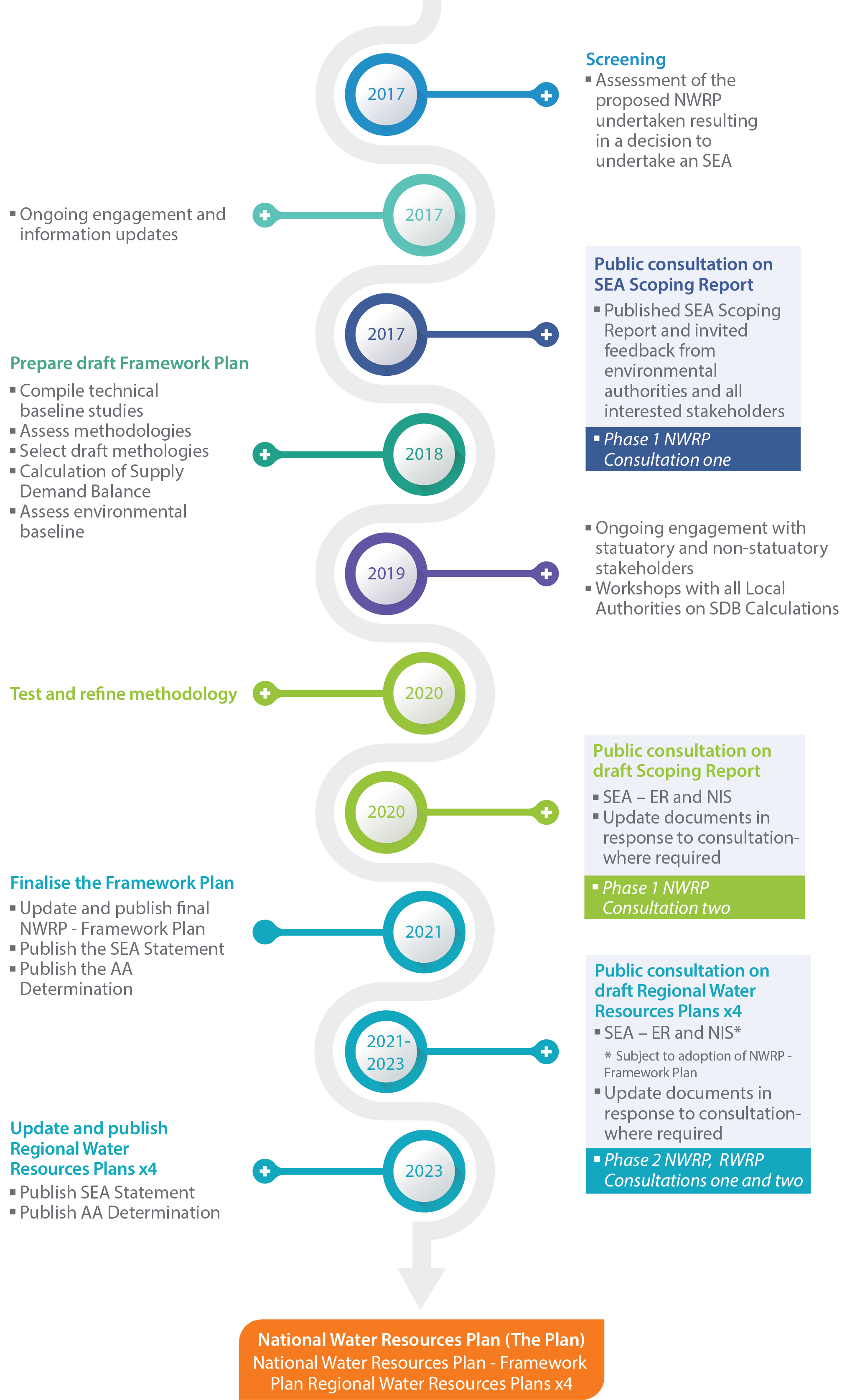
Previous Consultations
Phase 1 - NWRP Framework Plan - Consultation one
A first round of public consultation to inform the development of the Strategic Environmental Assessment (SEA) and Appropriate Assessment (AA), of the NWRP, took place from 9 November to 22 December 2017. For more information, view the Consultation one information leaflet.
We asked for feedback on the SEA Scoping Report and invited comments and suggestions for consideration at this stage.
A Consultation one report summarising the feedback received in the first round of consultation is available to view.
Subsequent to this process and informed by it, a draft NWRP Framework Plan with accompanying environmental reports were prepared and published for consultation.
Phase 1 - NWRP Framework Plan - Consultation two
The NWRP draft Framework Plan identified how we proposed to assess needs across all of our water supplies, and the process and methodology that we would use to find solutions to address those needs.
Consultation two invited feedback on the NWRP draft Framework Plan and associated SEA Environmental Report and Natura Impact Statement (NIS). A fourteen-week statutory public consultation took place from Tuesday 8 December 2020 to Friday 12 March 2021 during which time the NWRP draft Framework Plan and associated environmental reports were available to view and download at www.water.ie/nwrp and at local authority's planning offices or county libraries (depending on the local authority) during their normal opening hours. For more information, view the Consultation two information leaflet.
Following on from this public consultation the submissions and observations received have been taken into consideration, and the draft Framework Plan updated.
The NWRP Framework Plan has now been adopted, accompanied by a Strategic Environmental Assessment Statement and an Appropriate Assessment Determination.
A Consultation two report summarising the feedback received during Consultation two is also available to be viewed. This completed Phase 1- NWRP Framework Plan.
Phase 2 - Regional Water Resources Plan Consultations
Following the adoption of the National Water Resource Plan (NWRP) Framework Plan in the summer of 2021 we commenced phase 2 of the NWRP. This phase involved publishing four Regional Water Resources Plans for public consultation.
These plans are based on the methodology adopted in the Framework Plan and applying that methodology to the Regional Group Areas of Water Supplies that make up our national public water supply.
Each of the four draft RWRPs and associated environmental reports had their own public consultation phases and can be found here.
Heavily Modified Waterbodies report overview
In 2022, the EPA produced a technical report that proposed water bodies for designation as Heavily Modified Waterbodies (HMWBs). The proposed HMWBs were selected because they had undergone a significant alteration to their hydromorphology (the physical features of the environment that is holding the water in place) to provide a beneficial specified use and as a result it is not possible for them to reach GES (good environmental status) as their environmental objective to provide a beneficial specified use and as a result it is not possible for them to reach GES as their environmental objective. The specified uses considered were:
- Water storage and regulation (i.e. major impounding structures such as dams and reservoirs);
- Flood protection,
- The urban environment,
- Arterial drainage,
- Navigation.
A recommendation from this consultation was that the DHLGH should undertake the designation steps and consider if:
- Restoration measures necessary to achieve GES would have an adverse effect on the wider environment and on the specified use.
- There is no alternative means to supply the benefits of the specified use that, based on current knowledge, would be a:
• significantly better environmental option,
• technically feasible,
• and not disproportionately costly.
As a part of this consultation UÉ developed reports providing an overview of the;
- Waterbodies that are now designated HMWB for the purposes for water storage and regulation, and
- The need to maintain the impoundments or modifications to protect the existing public water supply.
The reports can be downloaded from the links below.
Accorrymore
Ballyshunnock
Bohernabreena
Doo Lough
Greagh Lough and Corcaghan Lough
Killsellagh
Lough Nambrackeagh
Lough Salt
Pollan Dam
St. Peters Reservoir Glencoagh Lough
Golden Falls, Poulaphouca and Leixlip Reservoir
Iniscarra Reservoir
Lough Derg Parteen Basin
National Water Resources Plan video series
National Water Resources Plan
National Water Resources Plan
Climate Change and the Environment
Climate Change and the Environment
Balancing Supply and Demand
Balancing Supply and Demand
Water Supply and Population Growth
Water Supply and Population Growth