
Category 2 & 3 customers
The Mogden formula is an internationally used method to calculate charges for the provision of trade effluent services. It ensures that customers are charge based on both:
- The volume of wastewater discharged, and
- The level of pollutants in that wastewater
This approach allows Uisce Éireann to recover the cost of collecting, treating, and disposing of trade effluent, while also encouraging businesses to reduce pollution levels.
UÉ’s Mogden formula is structured as follows:
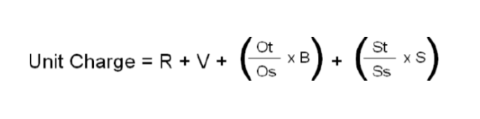
The formula calculates charges using a combination of fixed and variable factors:
Component | Description | Unit |
|---|---|---|
R | A fixed charge per cubic metre for reception and conveyance costs | m3 |
V | A fixed charge per cubic metre for volumetric and primary or preliminary treatment costs | m3 |
Ot | The Chemical Oxygen Demand (COD) of the customer's settled trade effluent | mg/l |
Os | The average national figure for COD of settled wastewater as determined by UÉ across all its wastewater treatment plants | mg/l |
B | The biological oxidation cost per cubic metre of settled wastewater of average strength | m3 |
St | The total suspended solids content of the customer's trade effluent | mg/l |
Ss | The average national figure for SS of settled wastewater as determined by UÉ across all its wastewater treatment plants | mg/l |
S | The charge per cubic metre for treatment and disposal of primary sludge from a wastewater treatment plant | m3 |
For Category 2 and 3 trade effluent customers, where sampling data is not available, Mogden charges will be calculated in line with the CRU’s confirmed Tariff Application Rules (TAR).
In this scenario, 30% of the customer’s Emission Limit Values (ELVs), as specified in their trade effluent licence, is used to estimate Chemical Oxygen Demand (COD) and Suspended Solids (SS) values.
This approach applies only in the absence of sampling data and is limited to a maximum of one tariff year (12 months), after which actual sampling data should be used where available.
As per the CRU decision, the “litres per working day” method is used to estimate the volume of sanitary wastewater discharged by trade effluent customers. This approach is adopted by many utilities based in the United Kingdom.
The following allowances apply:
- 25 litres per head per working day where there is no canteen on the premises serving hot meals: or
- 50 litres per head per working day where there is a canteen on the premises serving hot meals.
The estimated “per head” or “headcount” used for calculating the sanitary wastewater should reflect the average number of employees present on site during a typical working day. This includes all staff categories – seasonal, hybrid, temporary, and contract personnel and should result in “Effective Headcount”.
The estimated “per working day” is based on an 8-hour shift as a standard working day and should reflect the average number of employees working days per year. (260 days is an industry standard working-year assumption).
Annual sanitary volume (m³/year) = (Litres per day (25 or 50) * Effective Headcount present on site on typical day * Average number of employee working days per year (260)) / 1000.
The estimated sanitary wastewater volume is charged using the standard non-domestic wastewater volumetric tariff applicable to the wastewater band of the connection.
You can read more about the CRU’s confirmed decision here.